|
| THE
FEAST OF THE THIRD OF MAY
|
Monreale
and its own Crucifix
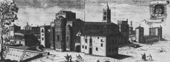 Monreale
is a town in the province of Palermo known all over the world for
its works of art: the Cathedral, built in 1172 by will of William
the Second called "the Good", is considered the greatest
example of sacred architecture of the Norman period.Situated
a few kilometres from Palermo on a hill that dominates the valley of
the "Conca d'Oro", today Monreale counts about
twenty-eight thousand inhabitants.The quarter of the "Ciambra"
developed around the Cathedral is the oldest nucleus of the town,
but the Church of the "Collegiata" assumes a particular
meaning for the presence of the image of the Crucifix. Monreale
is a town in the province of Palermo known all over the world for
its works of art: the Cathedral, built in 1172 by will of William
the Second called "the Good", is considered the greatest
example of sacred architecture of the Norman period.Situated
a few kilometres from Palermo on a hill that dominates the valley of
the "Conca d'Oro", today Monreale counts about
twenty-eight thousand inhabitants.The quarter of the "Ciambra"
developed around the Cathedral is the oldest nucleus of the town,
but the Church of the "Collegiata" assumes a particular
meaning for the presence of the image of the Crucifix.
THE "COLLEGIATA"
 The
Church of the "Collegiata" dedicated to the "SS.
Crocifisso" (the Holy Saviour) is situated on the mountain side
of the "Carrubella" quarter. Originally (since 1450) it
was a small church entrusted to the care of the Confraternity.
During the centuries it was enlarged thanks to the numerous
initiatives of the Canons and of the Archbishops (we remember the
institution of the Chapter thanks to the work of the Archbishop
Venero, 1618-1628), supported by the faith and by the contributions
of the followers.The church is rich in ornaments and furniture:
above the high altar, stucco-decorated by Giacomo Serpotta, lies the
famous sixteenth century Crucifix; at the altar's side two statues,
coming from the school of Serpotta, represent Saint Peter and Saint
Paul; in the nave four paintings by Marco Benefial (1724) rep The
Church of the "Collegiata" dedicated to the "SS.
Crocifisso" (the Holy Saviour) is situated on the mountain side
of the "Carrubella" quarter. Originally (since 1450) it
was a small church entrusted to the care of the Confraternity.
During the centuries it was enlarged thanks to the numerous
initiatives of the Canons and of the Archbishops (we remember the
institution of the Chapter thanks to the work of the Archbishop
Venero, 1618-1628), supported by the faith and by the contributions
of the followers.The church is rich in ornaments and furniture:
above the high altar, stucco-decorated by Giacomo Serpotta, lies the
famous sixteenth century Crucifix; at the altar's side two statues,
coming from the school of Serpotta, represent Saint Peter and Saint
Paul; in the nave four paintings by Marco Benefial (1724) rep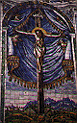 resent
the Deposition from the Cross, the Resurrection, the Apparition of
the Angel to MaryMagdalene and the Ascension respectively; on the
left aisle lies a decorated-woo Ciborium of the eighteenth century.Outside
the church, in the apse, a majolica panel about 50sqm. with 1500
tiles represents the Crucifix that blesses and watches over the town
of Monreale: it dates back to 1718. resent
the Deposition from the Cross, the Resurrection, the Apparition of
the Angel to MaryMagdalene and the Ascension respectively; on the
left aisle lies a decorated-woo Ciborium of the eighteenth century.Outside
the church, in the apse, a majolica panel about 50sqm. with 1500
tiles represents the Crucifix that blesses and watches over the town
of Monreale: it dates back to 1718.
THE
IMAGE OF THE CRUCIFIX AND ITS EXPRESSIONS
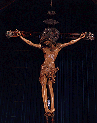 The
first testimony of the existence of the Crucifix in the Church of the
"SS. Salvatore" dates back to 1575, but the researches by Mgr.
Lorenzo Bertolino and the correlations with other similar images such as
the one of Assoro (Enna) determined not only the period of its creation
(the Confraternity ordered it to the Gagini's workshop between 1525 and
1535) but also that the order was executed by the most renowned and the
validest sculptor said "Antonello". The
first testimony of the existence of the Crucifix in the Church of the
"SS. Salvatore" dates back to 1575, but the researches by Mgr.
Lorenzo Bertolino and the correlations with other similar images such as
the one of Assoro (Enna) determined not only the period of its creation
(the Confraternity ordered it to the Gagini's workshop between 1525 and
1535) but also that the order was executed by the most renowned and the
validest sculptor said "Antonello".
 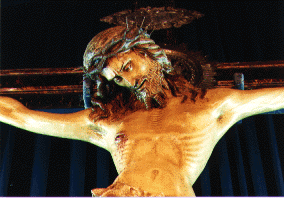 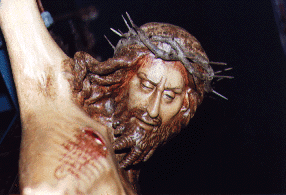
The
anatomy and the somatical perfections of the Crucifix, the detailed work
of its head and above all the different expressions of the Christ that
show the joy of the Redemption (Photo 1), the suffering for His
ungrateful sons (Photo 2) and the moment of the death (Photo 3) are the
characteristical signs of the author's greatest ability and of his
creative capacity.The present oak cross, covered in tortoise, was
substituted by the Canons of the "Collegiata" in 1700.
THE
CONFRATERNITY
 Today the Confraternity of the "SS.
Crocifisso" in Monreale is seated in the ex-church of "St.
Onofrio" thanks to the archbishop Mgr. Corrado Mingo who granted
the decree on May 25th, 1975. Today the Confraternity of the "SS.
Crocifisso" in Monreale is seated in the ex-church of "St.
Onofrio" thanks to the archbishop Mgr. Corrado Mingo who granted
the decree on May 25th, 1975.
The Confraternity is divided in:
- "Aspiranti"
below 15 years of age with 70 subscribed to date;
-
"Novizi"
between 15-18 years of age with 50 subscribed to date;
-
"Professi"
18 years and over with 240 subscribed to date.
The international relations are regulated
by a statute approved by an archiepiscopal decree on November 11th,
1996. After the election of January 12th, 1996, the board of directors is
constituted by one "superior", two "congiunti", for
councillors, two secretaries, one cashier and one novices-master.
THE "VARA"
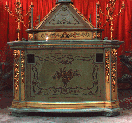
The "Vara" (a base to carry the
Crucifix) is a work of handicraftsmenship with all the requisites of a
real work of art.The first testimony of the existence of the
"Vara" dated back to 1638 after more than a decennium of
institution of the procession of the Crucifix. A lot of "Vare"
were built to date; the last one, that
is also the actual "Vara", was wanted in 1945 by the Committee
of the External Festivities. Restored many times (the last restoration
is by the artisan Gaetano Burgio), the "Vara"
presents the following aspect
s:
a) it is formed by a socle (1.60x1.60m)
where the Crucifix is set when it is brought down from the altar and by
a lower quadrangular base where the staffs are placed at a height of
1.50m;
b) the eight chestnut staffs measures
7.50m. altogether: each staff allows the intervention of 10 pairs of
"Fratelli" ( Brothers) to carry the "Vara" during
the procession for a total of 80 "Fratelli"
c) each side of this "Vara"
measures 2.30m. and it reaches a total eight of 7.60m. when the Crucifix
is set up;
d) the global weight of the
"Vara" ready for procession is about 4.5 tons.
THE
CLOTH AND THE "VUCI"

According to the description of Pitrè (an historian on
the Sicilian popular traditions) the "Fratelli" that
bare-footed carried on their bare-back the Crucifix put on only "drawers,
a white hanky on their hands, a red band round the waist with a
loose-fitting snow-white hanging cloth to hide the lower parts of the
trunk". Today, as a votive clothes, the "Fratelli" wear a
white shirt, a pair of white trousers and a red band from which a
snow-white cloth hangs: an embroidery with the image of Christ and an
inscription "W il SS. Crocifisso" (Long Live the Holy Crucifix)
adorn the same cloth. The "Vuci" (the typical votive
cry) that the "Fratelli" give during the procession to invoke
the graces from "U Patruzzu Amurusu" (the Loving Father)
during the procession originates from the old religious-literal
culture. To the cry, given by one "Fratello" who repeat one or
the other invocation, the "Fratelli" respond in chorus
"grazia" (grace), moving deeply for the feeling of its deep
religious sentiment and of its hope
who listen to it.
Today the procession winds along the same route
that the archbishop Venero traced out in 1626: it starts from the
"Collegiata" and passes through Via Antonio Veneziano and
Corso Pietro Novelli to the "Abbiviratura" (a drinking-trough
just outside the town). Here the procession returns back following the
same street until Via Garibaldi said "Scinnuta du Signuri" to
go on through Via Venero, Corso Pietro Novelli ("Varanni") and
Via Roma. After a full circle around Piazza Vittorio Emanuele II, it
continues for Via B. D'Acquisto returning up Via Palermo and finally
through Via Umberto I till the "Collegiata".
The procession
begins at 6:00 PM of the third of May and arrives at 2:00 AM the
following day.
Manifestation concerning the statue such as the
rubbing flowers and handkerchiefs on it to be taken to the sick and to
the absent and the children's kissing it at certain stations are
spectacular. A large crowd
(about 25.000 people) every year participates to the procession:
faithful from Sicily arrive at dawn and holding large candles with the
applied "Coppo" (a circular paper protection around the flame)
go for the procession (the so-called "Viaggio").
A moment of great attraction mixed with faith and
folklore arrives when the Crucifix reaches Piazza Spasimo: the
"Fratelli", satisfied with great fatigues after the difficult
"Scinnuta" (a slope), place the Crucifix at the centre of the
Piazza facing the valley of the "Conca d'Oro" as to extend his
blessing over the surrounding countryside, once considered a source of
life for many families. Fireworks in the Piazza Vittorio Emanuele II
complete a moment of great joy towards the venerated figure.
|